
Summary of Clinical Trial Results for the General Public (Lay Summary)
What is a "lay summary" in the context of clinical trials?
Upon completion of a clinical trial of medicinal products, the results of the clinical trial must be made available to the authorities and the public. In accordance with EU Regulation 536/2014 (Clinical Trials Regulation), the sponsor of the clinical trial must submit both a scientific summary of the results and a summary in a form that is understandable to the general public. This requirement applies regardless of the outcome of the clinical trial.
A new development in this context is the provision of a layperson’s summary. The rationale behind this requirement is to make study results more transparent throughout the EU. Both study participants and the general public should have access to this information.
Sponsors must upload the layperson summaries to the EU database via the EU portal CTIS (Clinical Trial Information System) (see figure below).
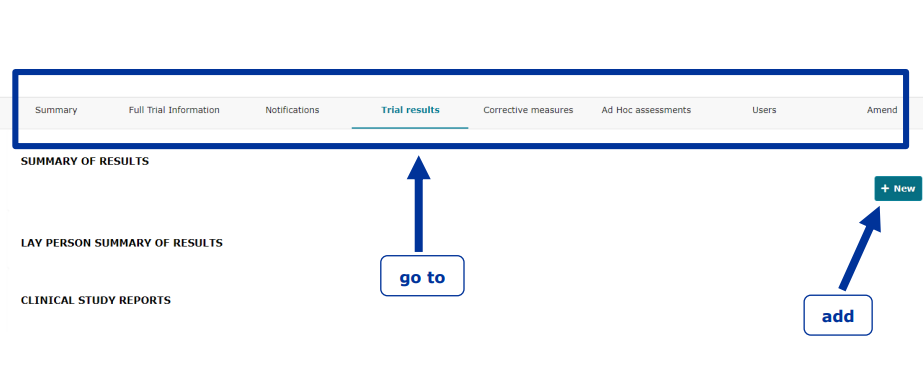
Source: EMA
The layperson's summary should include, among other things, the main objectives and overall results of the audit in an easy-to-understand format. EU Regulation 536/2014 lists the content requirements in Annex V:
1. Identification of the clinical trial (including the trial title, protocol code number, EU trial number, and other identification numbers)
2. Name and contact information of the sponsor
3. General information about the clinical trial (including where and when the trial was conducted, the trial’s primary objectives, and an explanation of the reasons for conducting the trial)
4. Group of test participants (including information on the actual number of people included in the test in the Member State in question, the Union, and in third countries; breakdown by age group and gender; inclusion and exclusion criteria)
5. Test Preparations Used
6. Description of Side Effects and Their Frequency
7. Overall Results of the Clinical Trial
8. Comments on the Results of the Clinical Trial
9. Indication of whether further clinical trials are planned
10. Information on where to find additional details
When is the lay summary due?
The layperson’s summary was introduced with the adoption of EU Regulation 536/2014 (Clinical Trials Regulation) and is therefore mandatory for all completed clinical trials of medicinal products conducted under this regulation. Regardless of the clinical trial’s outcome, the summary must be submitted in all Member States within one year of the trial’s completion. For pediatric studies, it must be submitted within six months of the study’s completion.
What should be taken into account when preparing a lay summary?
When developing a summary for laypeople, it is important to keep in mind that the information is intended for a general audience and therefore should not assume any prior knowledge of the study, medical terminology, or clinical research in general. The layout and content must be tailored to the needs of the general public in terms of style, language, and language level.
A well-written lay summary is usually easy for young people aged 12 and older to understand. For pediatric studies, a child-friendly version of the lay summary should be considered, meaning that the presentation and style are adapted (with more illustrations or graphics) to make it easier for children to understand the study results.
Patients or laypeople should be involved in reviewing the summary to assess the clarity and value of the information. Authors with specific experience in writing in plain language for the general public—who are also able to take into account the scientific background and numerical data—can be helpful in drafting summaries for laypeople.
The EU Expert Group on Clinical Trials recommends that these lay summaries be made available in all the languages of the countries where the study took place. As a guideline, this should include the languages for which patient information and informed consent forms are already available. In addition, an English lay summary is also recommended if it is not already included among the languages or countries listed. This is intended to improve accessibility within the EU and worldwide.
Are readability tests required for lay summaries?
By requiring the abstract to be uploaded to the EU portal, the relevant authorities and ethics committees are made aware of the availability of the layperson’s summary and, consequently, of its content.
The EU Expert Group on Clinical Trials recommends conducting a readability/comprehension test (Readability User Test) of lay summaries by test subjects from the target population, and this is considered good practice. As a result, this requirement falls under what is known as “soft law,” meaning it reflects the expectations of the regulatory authorities; failure to comply should therefore be well-justified.
Where can I get help with my lay summaries?
Developing lay summaries requires experience in writing for a general audience and a fundamentally different approach than that used when writing for regulatory or scientific purposes.
The readability test identifies potential comprehension issues and then determines whether addressing those issues leads to improvements.
This is a diagnostic, step-by-step process that is routinely used to evaluate the readability of package inserts for medications.
Beate Beime Pharma Consulting has many years of experience in editing and testing the readability of package inserts and can provide you with expert support in the following areas:
Preparation of layperson summaries in terms of layout and content
Conducting readability tests with test subjects who have different
They have diverse educational backgrounds, literary experiences, ages, and genders, and thus represent the general public.
Sources:
EU Regulation 536/2014
Recommendations of the Expert Group on Clinical Trials for the Implementation of Regulation (EU) No. 536/2014 on Clinical Trials of Medicinal Products for Human Use
Guidance on Good Lay Summary Practice